Samstag, 30. Mai 2015

Pioneers in Endoscopy

basil hirschowitz circa1960 1


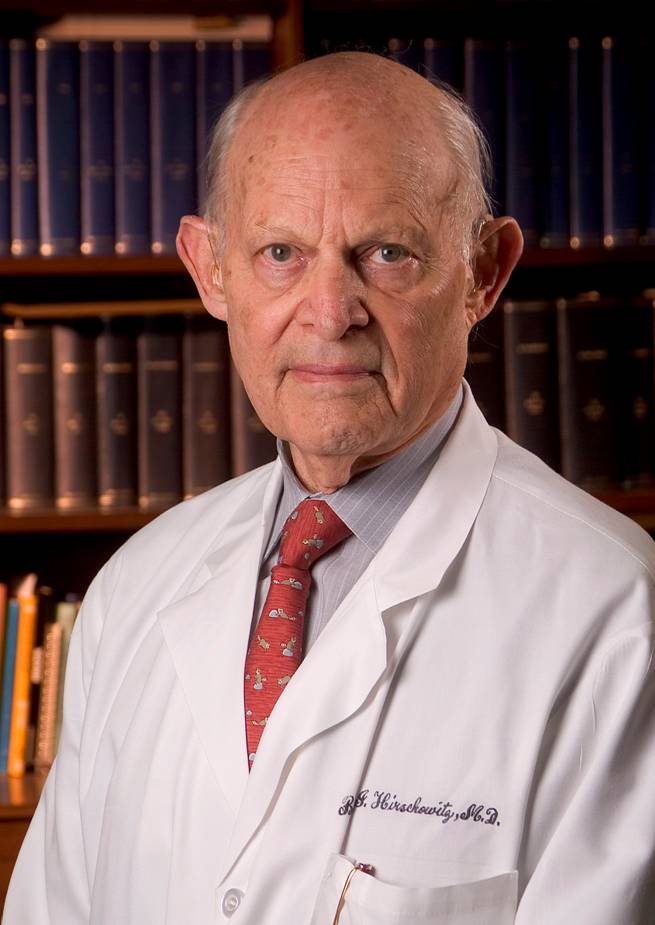
 Dr. Basil Isaac Hirschowitz

A tribute to one of the most important developers in Endoscopy, Dr. Basil Isaac Hirschowitz. We remember Dr. Hirschowitz on his birthday, 29th May. He was born 1925 and passed away 1913.

Dr. Hirschowith was a native of South Africa, born in the city Bethal. He received his medical education at the University of the Witwatersrand in Johannesburg. In 1947 Dr. Hirschowitz earned M.B and B.Ch. degrees of this institution. He received Postdoctoral training from the University of the Witwatersrand, earning an M.D degree. 1953 he moved to the United States. He continued at the University of Michigan with his gastrointestinal fellowship.

Dr. Basil Hirschowitz is best known for having invented an improved Optical Fiber Endoscope for gastroenterology. Creation of the flexible Fiber Endoscope revolutionized the practice of gastroenterology and was also a key invention in optical fiber communication in multiple industries. Never the less he used for illumination of his first flexible Fiber Endoscope a conventional light bulb.

Using fibers for illumination ( cold light) was later added by the inventors of American Cystoscope Makers and Karl Storz.

Dienstag, 7. April 2015

Endoscopic History - Founders and Inventors


Karl Storz - Founder and Inventor

In 1945, Karl Storz founded a company for manufacturing ENT instruments, headlamps, and binocular loups. This interest in medical vision, illumination, and hence physics consequently led him to spezialize in endoscopes. He was fascinated by the idea of endoscopes that allow physicians to look inside the body. At the time, the technical resources available for this purpose were still extremly limited. The examination site was illuminated using tiny, faint light bulbs, or mirrors were used to reflect external light through the endoscope tube into the body. Karl Storz quickly recognized that these methods could not achieve satisfactory illumination. He wanted to find a better way.

Two competing chracteristics benefited him in this quest: a craftsman´s sure instinct for preciese workmanship and technical feasibility on the one hand and an artist´s and inventor´s imagination on the other. His illumination solution for endoscopy is still in use today: Light generated externally by a powerful light source is transmitted into the body through a flexible fiber optic light cable. This "cold light illumination" principle laid the foundation for modern entoscopy as well as for the success of the KARL STORZ company. With more than 400 additional patents and utility models, Karl Storz has made significant impact on modern endoscopy.

(Text by Karl Storz Company delivered by Michael Künze/Karl Storz)

Montag, 6. April 2015

Endoscopic History ENT


Anton Friedrich von Tröltsch (1829 - 1890)

Anton Friedrich von Tröltsch is considered as the "Father of ENT medicine" in Germany. He was the one that added the illumination method with the reflecting mirror, developed by Hofmann (Fig. 1) into the daily clinical routine.
He gave lectures - trained by Tonybee and Wilde in England - as the first one in Germany about Otology at the Würzburg University. His published textbook of 1862 was widely circulated.
Besides his bust in the Würzburg Department of Otolaryngology and a small side street - named after him in Würzburg - reminded the angulated ear forceps (Fig. 2) to these truthfull great man of our medical field.
By Fig. 3 Tröltsch is shown during treatment of a patient. This image has been published in 1880 in a "Home Story" at the German magazine "Gartenlaube" in which he is praised in the skies. Also his presentation of the lighting mirror left downwards in the picture is of interest.


Fig. 1                                                             Fig. 2                                               Fig. 3

( Text: Dr. Lübbers, delivered by Michael Künze / Karl Storz Germany)

Dienstag, 3. Februar 2015

Endoscopic History Methodology


For endoscopic applications four product groups are used:
  •  endoscopes, 
  • surgical instruments, 
  • mechatronic devices 
  • documentation. 
       

Each group has its own historical development and was included in endoscopic applications at different times.
Endoscopic applications have spread with inventions of instruments and equipment across all disciplines. The relationship between inventions and applications is shown in the corresponding field under "Material and Methods"
The representation captures the previous application and the progress which is achieved by the new surgical technique, as well as structural characteristics of the material required.
Special attention is dedicated to the representation of anatomical foundations which do not only influences the surgical technique but also the design of the instrument used.
For better organization as well for the field of application as well for the product groups symbols are used and time specifications are inserted. Thereby posts can also arranged afterwards as well thematically as well chronologically. Endoscopic History can be used for e-learning or as a text-book.